
ABOUT AI - Part 2: How is AI built?
Sep 28, 2026Welcome to Part 2 of our five-part About AI series.
Here we are looking at the layers that go into creating an AI system, without disappearing into coding, maths or technical jargon. Understanding a little more about how AI is built can also help you understand the results you get from it.
It is easy to imagine AI as a gigantic digital library that searches through everything it knows, finds the answer you need and pastes it back to you. That isn't really what is happening.
AI is not programmed with every possible answer. It is trained to recognise patterns.
In this section, we follow the process from the original training data through to the finished system you actually interact with.
1. The Training Data
AI models are trained using enormous amounts of data.
Depending on the model, this can include information from public online sources, licensed material, private datasets and synthetic data, across formats such as:
- text
- code
- images
- video
- audio
This information is not simply stored inside the AI like files in a filing cabinet. Instead, the system uses it to learn patterns, relationships and structures within the material.
Training data is also processed and filtered before being used. Depending on the model and developer, this can include removing duplicate material, low quality content, harmful content or other data that shouldn't be included.
This is also where the idea of AI as a mirror starts to make more sense.
AI learns from human created material, so it can also reflect patterns and biases contained within that material. Bias can also enter through choices made during development, including how data is selected, labelled and used.
So when AI produces something biased, it is not creating that bias in isolation. Part of what we are seeing reflected back comes from human created systems, human created data and human choices.
2. Machine Learning and Deep Learning
This is where the system begins learning from the data it has been given.
Machine learning (ML) allows a system to learn patterns from data rather than being explicitly programmed for every possible situation.
Deep learning (DL) is a form of machine learning that uses neural networks with many layers. It is especially useful when working with large and complex types of data such as language, images, audio and video.
Deep learning sits behind many of the AI systems people are now familiar with, including language translation, image recognition, virtual assistants and generative AI. These layers gradually learn increasingly complex patterns.
In an image system, for example, earlier layers might recognise edges and simple shapes, while later layers may recognise more complex features and objects.
Neural Networks
To keep this as simple as possible, neural networks are mathematical systems loosely inspired by the way biological neural networks process information.
They are made up of interconnected layers of artificial neurons that work together to recognise patterns and produce results.
Inside the network are parameters - internal numerical settings that are adjusted during training. Together, these parameters hold the patterns the model has learned.
3. The Training Process
During training, the model repeatedly makes predictions based on examples in the data. It compares those predictions with the expected result, adjusts its internal parameters and tries again. This happens again and again on an enormous scale.
You can visualise it as the system carrying out millions or billions of tiny prediction exercises, gradually becoming better at recognising the patterns contained within the data.
This process creates what is often called a base model. But a base model is not necessarily the finished AI system you end up using.
4. From Base Model to Usable AI
After the initial training, the model can go through further stages that shape how it behaves and responds. This might include:
- additional fine-tuning
- human feedback
- safety training
- system instructions
- specialist tools
- access to search, files, code, images or other capabilities
This is where much of the model's behaviour, tone and operating style can be shaped.
If you have used several conversational AI systems, you may already have noticed that they can feel quite different. One may sound warmer and more conversational. Another may feel sharper, more concise or more task-focused.
Users may experience this difference as the AI's “personality”, although it is better understood as behaviour shaped through training, instructions, design and product choices rather than an independent personality in the human sense.
This is also one reason different AI systems can produce noticeably different responses even when asked the same question.
5. Safety Testing and Guardrails
Before an AI model is released, developers test it across areas such as capability, reliability and safety. There are several layers to this.
Safety training helps shape how the model behaves during post-training.
Guardrails add protections around the finished system. These can include input and output filtering, permission controls, monitoring and other restrictions.
Evaluation and red teaming are used to deliberately look for weaknesses.
Red teams can include people or automated systems trying to uncover unsafe behaviour, security vulnerabilities, bias, reliability problems or ways of bypassing safeguards.
This testing does not necessarily stop once the model is released. Systems can continue to be monitored and evaluated as they are used in the real world.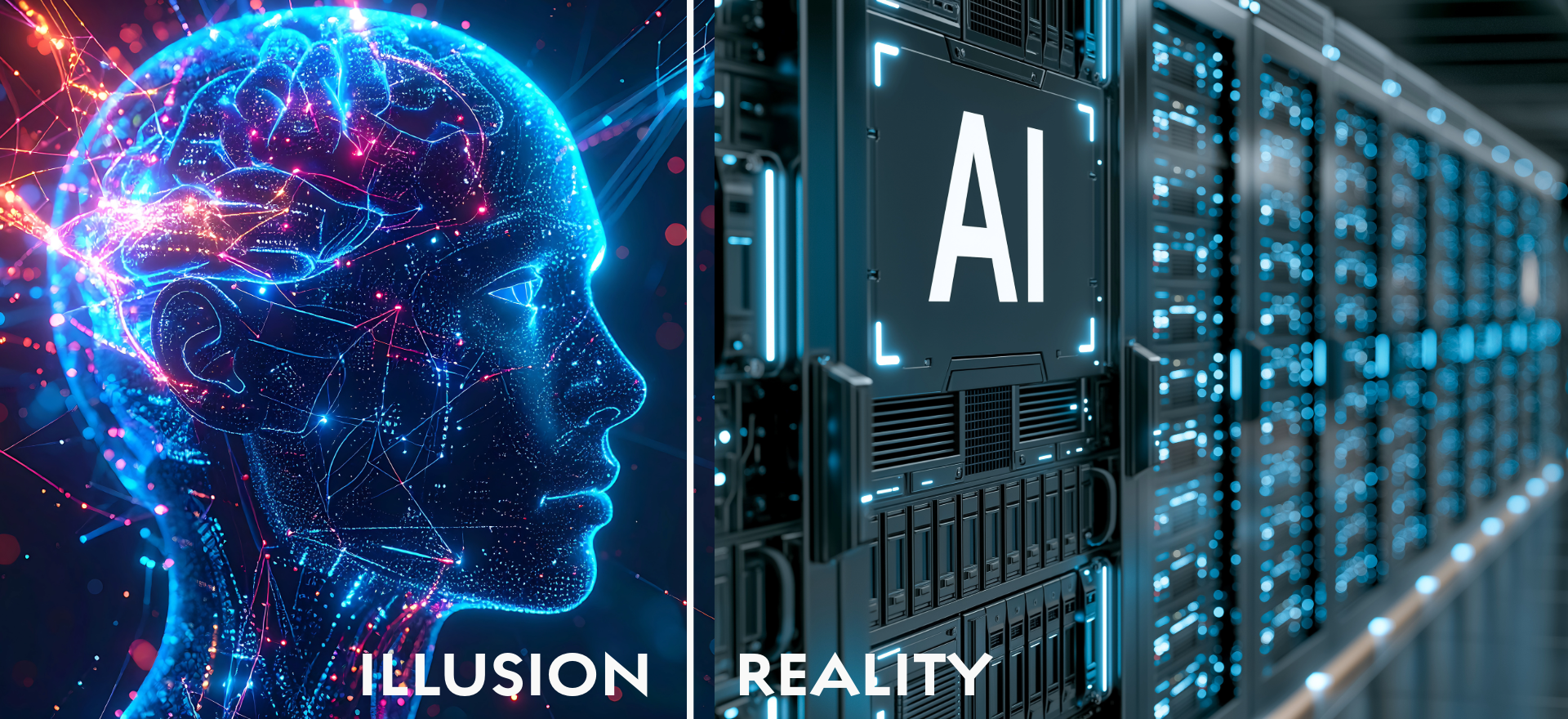
The Physical Side: Data Centres
AI can feel invisible.
When people picture it, they may imagine a translucent human figure, glowing circuits or some mysterious intelligence floating somewhere in “the cloud”. The reality is considerably less glamorous.
AI systems depend on very physical infrastructure: rows and rows of servers housed inside enormous data centres. That infrastructure includes:
- specialised chips such as GPUs
- electricity
- cooling systems
- networking equipment
- storage
- large physical facilities
All of this requires substantial resources to build and operate. Electricity and water are needed to power and cool many data centres, while specialised processors depend on raw materials and complex global supply chains.
This creates important questions around the environmental impact and sustainability of rapidly expanding AI infrastructure.
The intelligence may feel invisible, but the machinery behind it is very real.
Training vs Using the Model
There is one final distinction worth understanding.
Training is the process of building the model and adjusting its parameters using large amounts of data.
Inference is what happens when the trained model receives a new input and produces a response.
So when you ask an AI a question, it is generally not retraining itself from scratch. It is using patterns learned during training, together with the current conversation, instructions and any tools available to it, to generate its response.
By now, you should have a clearer picture of how an AI system moves from raw data to the finished model you interact with. Different data, training methods, tools, instructions and safety systems can all help shape what a particular model knows, what it can do and how it responds.
AI is built by exposing a model to enormous amounts of data, training it to recognise patterns, refining how it behaves, and running it on powerful computing infrastructure.
NEXT — Part 3: What Is AI Actually Doing When It Talks to You?