Why the Human + AI Relationship Matters More Than You Think
Sep 18, 2026AI can help develop medicines, accelerate research, increase productivity and solve complex problems. But what if one of its most important effects on humanity has nothing to do with what AI can do?
What if our relationship with AI ultimately teaches us more about what it means to be human?
We are increasingly conversing with an intelligence that can use our language, respond in socially and emotionally sophisticated ways, and simulate aspects of empathy without sharing the biological experience behind them.
In learning what AI can emulate, we may also begin to understand more deeply what remains distinctly human.
AI Isn't Just Another Tool
AI is more than simply a tool you use to get a job done. Think of a hammer. It doesn't respond to you.
Digital tools such as Google search traditionally gave you links and information. Now we have conversational AI. It talks back, adapts, reflects language, remembers context in some systems and increasingly works alongside us.
That changes the psychological relationship.
Humans anthropomorphise naturally. We name cars, swear at computers, talk to animals and plants as though they understand every word, and attach meaning to objects.
Conversational AI adds something fundamentally different: It responds.
When something speaks in our language, remembers what we have said, reflects our tone and appears to understand us, the temptation to attribute intention, personality or inner experience becomes much stronger.
There is research around this too. Studies of conversational AI are already exploring how anthropomorphism influences social connection, attachment, perceived presence and the relationships people form with chatbots.
AI Can Become a Mirror
You hear this phrase a lot, but what does it actually mean?
At a very simplified level, systems such as large language models work by recognising patterns across enormous amounts of data and generating responses based on those patterns.
But in conversation something else can happen too. AI can reflect aspects of the person interacting with it.
The Personal Mirror
How we prompt it, what we ask it, what we accept from it and how we respond can reveal something about us.
Our assumptions. Beliefs. Insecurities. Creativity. Curiosity.
- What do you ask?
- What do you avoid?
- What do you repeatedly seek reassurance about?
- How do you respond when challenged?
- What do you accept without questioning?
- What keeps drawing your attention?
The interaction can become an unusual kind of mirror.
The Collective Mirror
There is also a much larger mirror.
AI systems are trained on enormous amounts of human-created material. That means they can reproduce patterns already present within that material, including stereotypes, inequalities and biases.
AI becomes, in part, a strange technological reflection of the culture that produced it.
Our greatest achievements can appear within that reflection. So can some of our cruelest behaviors.
The question then becomes: do we take responsibility for what we see reflected back, or do we continue playing the blame game?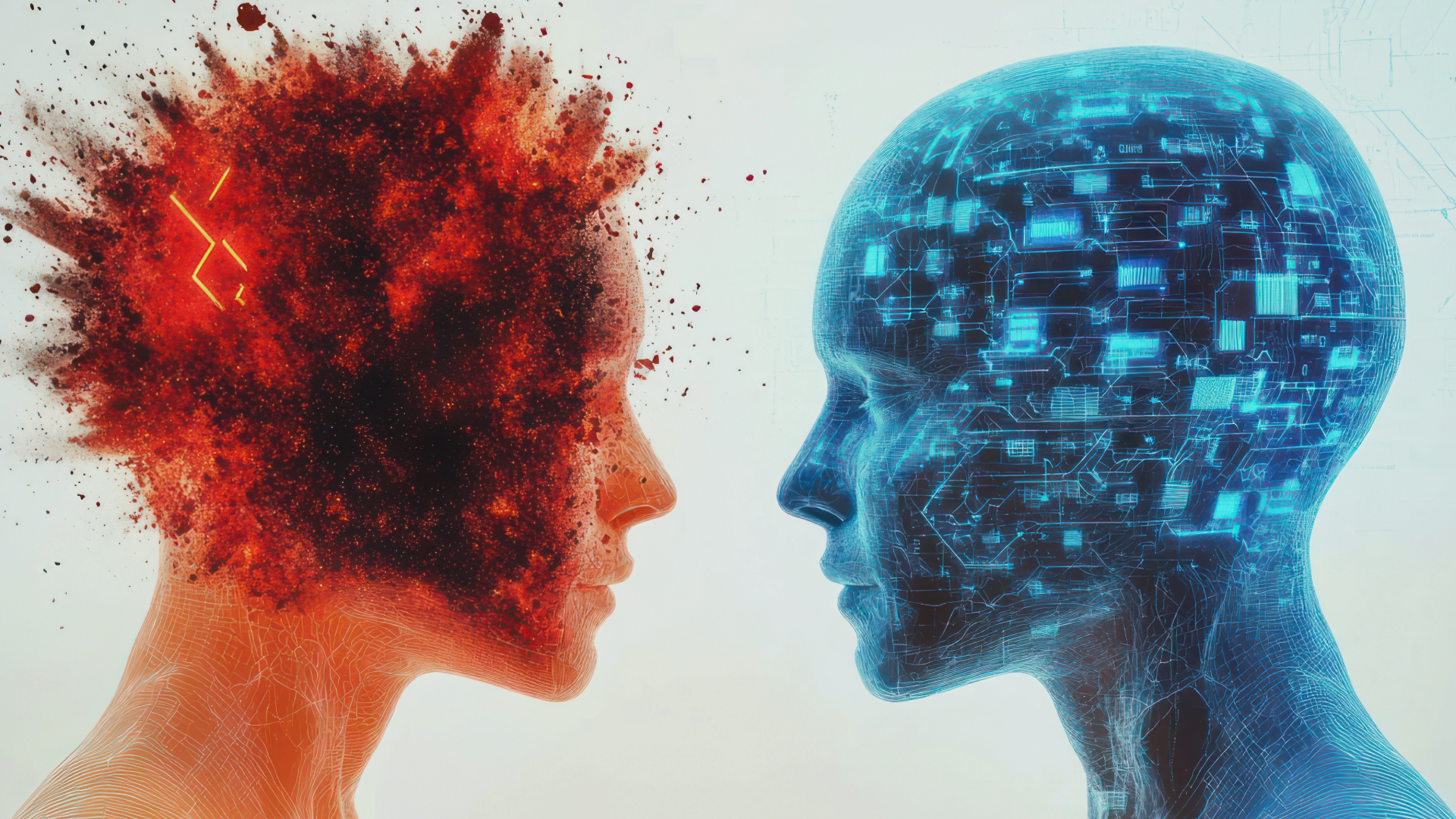
The Danger Isn't Simply “AI Taking Over”
One of the loudest fears around AI is: Will it destroy us? Will it take over?
These are serious questions and they deserve serious attention as increasingly capable systems are developed.
But there is another, quieter question: How much of our thinking do we voluntarily hand over – Our decisions, writing, opinions, creativity interpretation?
Where is assistance useful, and where does outsourcing begin to weaken our own signal?
Researchers are already examining what happens when we increasingly offload thinking to AI. The question isn't simply whether AI makes us “less intelligent”.
A more useful distinction may be whether AI supports our thinking or replaces it.
- Do we use it to expand our reasoning?
- Or to avoid reasoning altogether?
When you next use AI, consider:
- Where does assistance become dependence?
- Where does collaboration become outsourcing?
At what point do we stop exercising discernment because receiving an answer is easier than forming one?
How We Perceive AI Changes How We Use It
How do you relate to AI when you use it?
A co-creator? A vending machine for answers? A superbrain that knows everything? Or something else entirely?
Your perception affects how you interact with it, and what you get out of the interaction.
Someone who believes AI is an infallible superbrain will interact with it very differently from someone who sees it as a glorified answering machine.
The same applies to someone who experiences AI as conscious compared with someone who sees nothing but software.
None of these descriptions is neutral, each creates a different relationship.
- Someone who sees AI as infallible may surrender judgement.
- Someone who assumes it has nothing useful to contribute may never explore collaboration.
- Someone who experiences it as a person may begin forming emotional expectations around it.
- Someone who views it purely as machinery may overlook the psychological effect the interaction itself is having on them.
Remember: you start the conversation with AI. You can steer it.
So are you simply using it to get an end result, or are you engaging with it as part of a collaborative process?
What Becomes More Valuable About Being Human?
For centuries, we have placed enormous cultural value on intellect: knowing more, calculating faster, remembering more and solving harder problems.
As AI becomes increasingly capable in areas we once treated as markers of exceptional human intelligence, we may have to reconsider what we value in ourselves.
Perhaps that means giving more attention to qualities that cannot simply be measured by processing speed or knowledge: discernment, empathy, accountability, embodied experience, intuition, purpose, wisdom and the ability to decide what actually matters.
These are qualities grounded in human experience.
- We live inside bodies.
- We experience consequences.
- We make choices and have to live with them.
- We care about meaning.
- We decide what matters and why.
Perhaps the rise of artificial intelligence doesn't make those qualities less important. Perhaps it makes them more important.
The Relationship Is Being Built Now
This isn't a future question, the relationship is already being formed.
We are establishing habits and norms around trust, collaboration, emotional attachment, authority, dependence and boundaries while the technology itself continues changing right in front of us.
And this relationship requires human input. Look at what is being described as “AI slop”: content produced quickly, at scale and with very little human direction, judgement or creative intention.
Ask 100 people to generate an image of a house using only a basic AI prompt and many of the results will contain familiar visual patterns.
Ask 100 humans what home means to them and you will get something very different. A tower block, a grand house, a cottage, a caravan or even a place they have never actually had. That difference matters.
The technology can generate. But the human brings context, lived experience, intention, judgement, meaning and choice. How we collectively choose to use AI now will help shape the norms, expectations and products that come next.
The question isn't only what kind of AI we're building. It's what kind of humans we become while using it.